

Biweekly vs Semi-Monthly Pay - What Every Employee Should Know
Biweekly vs semi-monthly pay: see how 26 vs 24 paychecks affect your budget, benefits, and tax withholding. Comparison table and FAQ included.
This tool works offline
No internet connection needed.
See fully accurate information to calculate when your next biweekly payroll schedule happens. View the complete calendar info with the total paychecks left for an easier financial budgeting plan. Get to know what months you will get a triple paycheck in a single month.
Understanding when your next biweekly pay date schedule is really confusing. Especially for a new employee who never paid that way. We will explain it to you as easily as possible. The goal is to make you understand the whole biweekly pay cycle concept clearly.
What is a biweekly payroll system, and how does it work?
A biweekly pay schedule means you receive a paycheck every two weeks. In most cases, you will receive 26 pay periods per year.
One year has 52 weeks. With biweekly pay (every two weeks), you get 26 paychecks per year. 52 weeks / 2 = 26 paychecks. For the specific dates you get paid depend on your employer's chosen pay cycle start date. Please confirm with your payroll departments.
Why I got paid less on my biweekly pay stub?
It's because the biweekly pay system is different from a semi-monthly cycle. Looks like they are similar, but they're not the same thing.
Semi-monthly means you get paid two times each month. Most people get paid on the 1st and the 15th. This gives you 24 paychecks in a year. It's like taking your monthly pay and splitting it into two parts. For example, you got paid $4,000 per month. Then you will receive $2,000 each. $4,000 / 2 = $2,000 per pay stub.
Meanwhile, the biweekly pay schedule happens every 14 calendar days regardless of the month, which is why you end up with 26 paychecks per year. For example, you got paid $4,000 per month, $48,000 annually. Then you will receive $1,846.15 per pay stub.
Feels less, right? In fact, it's not. It's because the biweekly pay system is calculated from your annual salary, divided by 26. $48,000 / 26 = $1,846.15 per pay stub. Because of that, some months you will receive a triple paycheck instead of two.
Use our biweekly paycheck calculator to see the accurate results how much you will receive on every pay stub.
What does this triple paycheck mean on biweekly pay? When did that happen?
It's because you are getting paid 26 times per year instead of 24 (semi-monthly).
26 paychecks per year means you get paid every 14 days. Most months, you get 2 paychecks. But some months you get 3 paychecks because of how the 14-day schedule works out.
When you get 3 paychecks in one month, it feels like extra money. But it's not really a bonus. You're not making more money for the year paychecks overall.
How to use our biweekly pay schedule date calculator?
Results will show your next biweekly payment schedule date till the end of the year. It also shows when you will get 3 paychecks in a single month, marked in green badge.
Old paychecks will appear grayed out with a line through them.
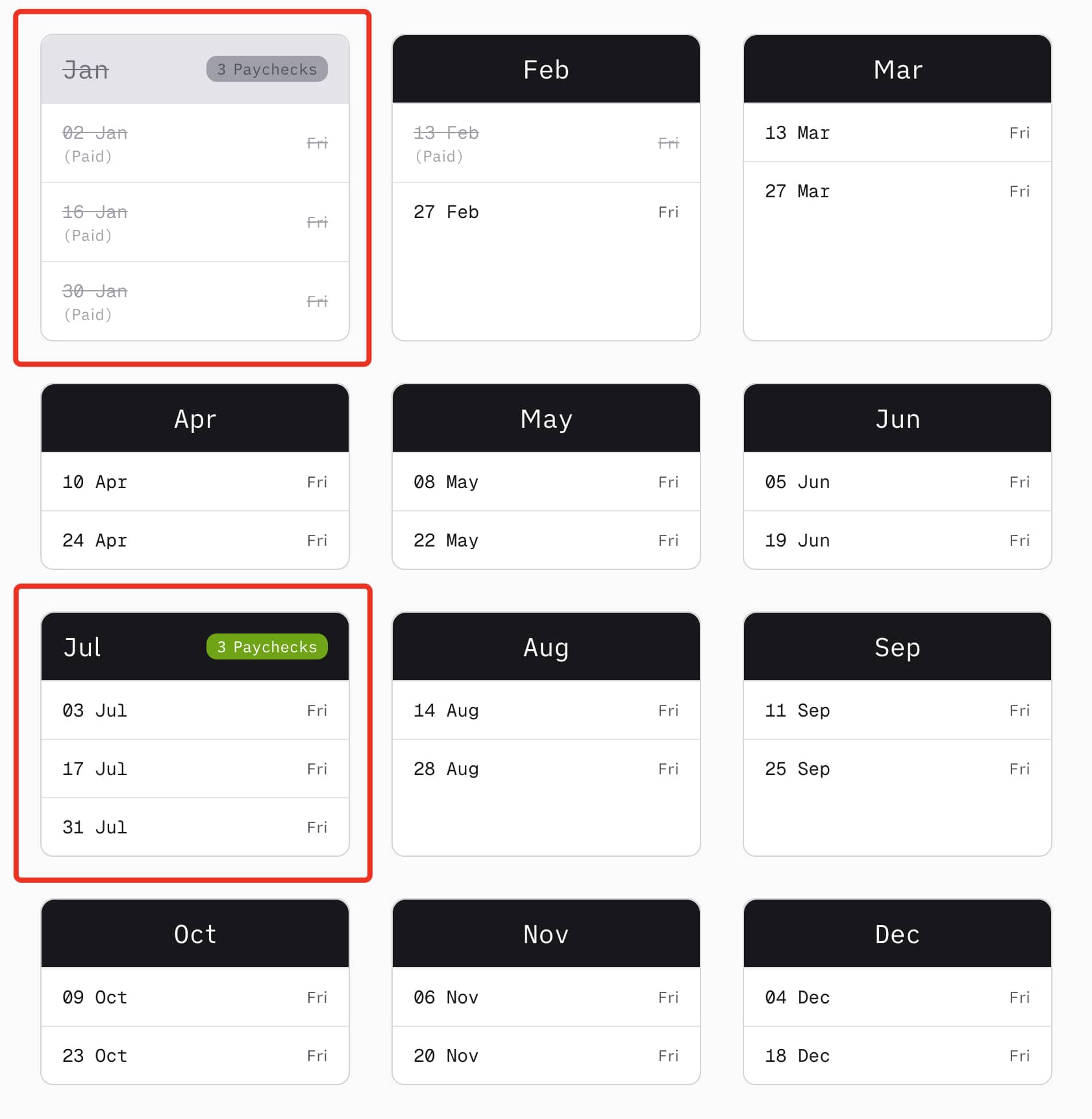
You will also get the information on how many paychecks are left till the end of the year. So, you can have a better budgeting strategy. Especially if you are having a recurring monthly subscription.
Learn more about this topic from our blog.
Biweekly vs semi-monthly pay: see how 26 vs 24 paychecks affect your budget, benefits, and tax withholding. Comparison table and FAQ included.
Plan ahead with the complete biweekly pay period schedule 2026. All pay dates, holiday adjustments, and 3-paycheck months in one printable calendar.
See when exact information on how many biweekly pay periods there are in 2026 and when the paycheck will arrive. So, you can plan financially better in 2026.
Lost in biweekly pay cycles after usually getting paid monthly? Don't worry, we'll break down all the important stuff you need to know to understand the system.
Guessing which months in a year give you the three paychecks is not that easy. It needs some manual work to do and is pretty complicated.
Having a good salary is a everyone's dream. A salary that is not only lasted check per check. But also makes you happy, enjoy every moment, and live your life.
Check these related payroll and financial planning tools.
This tool works offline
No internet connection needed.