

Starting a new year will always be an exciting and yet challenging path. We don't know what will happen in the future.
Getting paid on a biweekly cycle can bring both benefits and confusion to your financial situation. You receive your salary more frequently, but you also need to manage your monthly budget wisely.
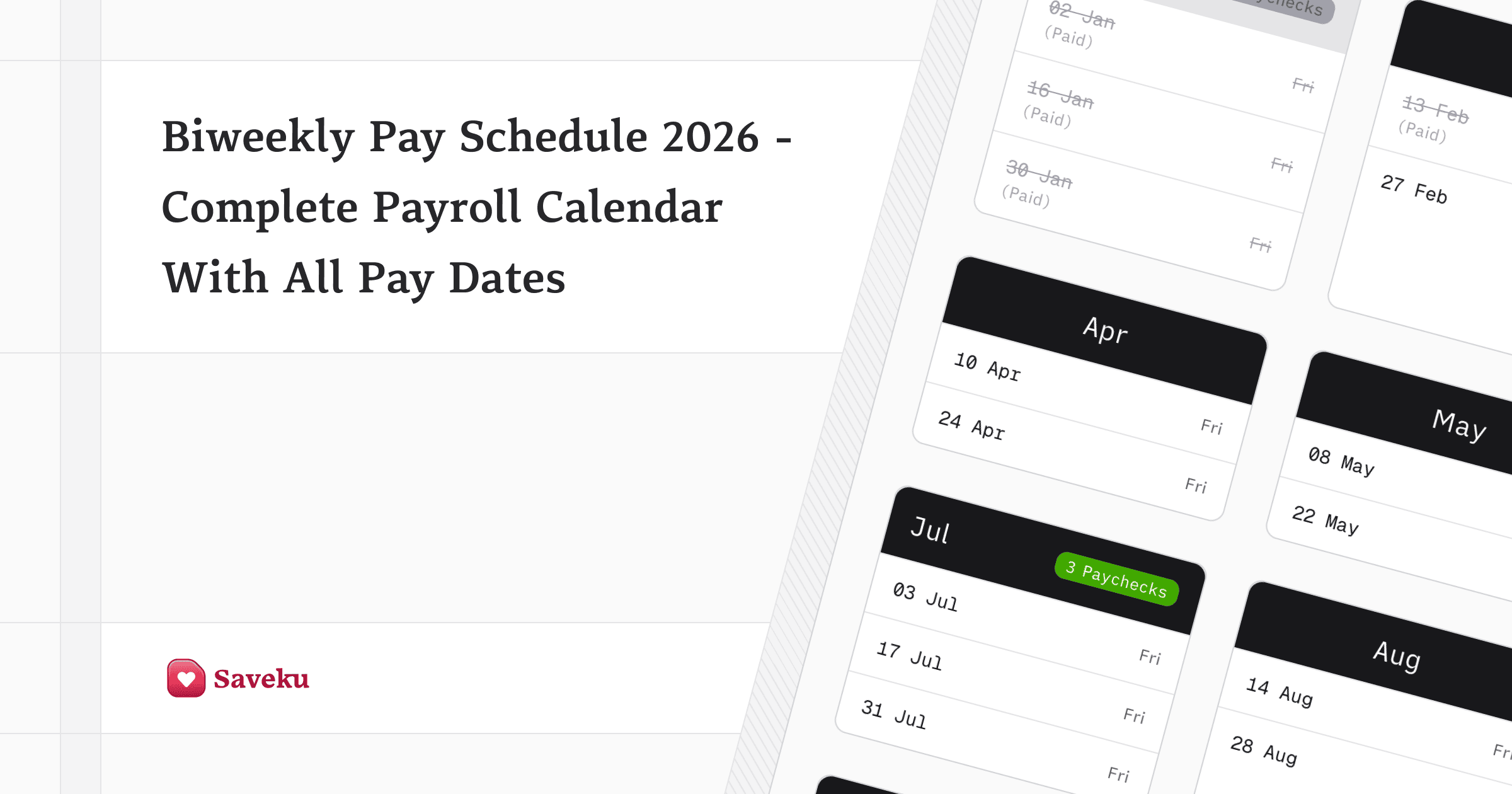
Below, you'll find a complete biweekly payroll calendar 2026 covering the most common start dates, a breakdown of how pay periods work, and a printable calendar resource you can keep at your desk all year long.
Use our Biweekly pay date calculator to enter your last paycheck date and see all your upcoming pay dates in 2026.
How a biweekly pay schedule works
A biweekly pay schedule means you receive a paycheck every two weeks. In most cases, you will receive 26 pay periods per year.
One year has 52 weeks. With biweekly pay (every two weeks), you get 26 paychecks per year. 52 weeks / 2 = 26 paychecks.
The specific dates you get paid depend on your employer's chosen pay cycle start date. The most common biweekly pay dates 2026 begin on either January 2, January 5, or January 16, with paychecks arriving every other Friday after that.
What's the difference between biweekly vs semi monthly pay cycles?
It's easy to confuse biweekly pay with semi-monthly pay, but they're not the same thing.
Semi-monthly means you're paid twice per month, usually on the 1st and the 15th for a total of 24 paychecks per year.
Biweekly pay, on the other hand, happens every 14 calendar days regardless of the month, which is why you end up with 26 paychecks per year.
This is important for budgeting. With biweekly pay, some months have three paychecks instead of two. In 2026, which months these are depends on when you started getting paid. We show them in the calendars below.
How to check your personal biweekly pay schedule
Not sure which schedule applies to you? Here's how to figure it out:
- Check your most recent pay stub. Look at the pay period end date and the check date (the day you actually received payment).
- Count forward in 14-day increments. Your next paycheck will arrive exactly two weeks from your last one.
- Ask your HR or payroll department. They can confirm your company's official biweekly pay period schedule 2026 and whether there are any holiday adjustments.
- Use our biweekly pay calculator. Enter your last pay date, and the tool will generate your complete biweekly pay schedule for 2026 all dates included. Try the calculator here.
Some employers pay early if their payday lands on a holiday or weekend. We show these changes in the calendars below.
Complete biweekly pay schedule for 2026 — All dates
Below are the three most common biweekly payroll calendar 2026 options. Find the one that matches your pay cycle and you'll have every pay date for the year.
Schedule A: 2026 biweekly pay dates starting January 2
This schedule applies if your first paycheck of 2026 lands on Friday, January 2. This is one of the most common start dates for employers whose biweekly cycle begins at the start of the calendar year.
| Pay Period | Pay Date | Notes |
|---|---|---|
| 1 | January 2, 2026 | First pay of the year |
| 2 | January 16, 2026 | |
| 3 | January 30, 2026 | ⭐ 3rd paycheck in January |
| 4 | February 13, 2026 | |
| 5 | February 27, 2026 | |
| 6 | March 13, 2026 | |
| 7 | March 27, 2026 | |
| 8 | April 10, 2026 | |
| 9 | April 24, 2026 | |
| 10 | May 8, 2026 | |
| 11 | May 22, 2026 | |
| 12 | June 5, 2026 | |
| 13 | June 19, 2026 | |
| 14 | July 3, 2026 | May be paid early (July 4 holiday) |
| 15 | July 17, 2026 | |
| 16 | July 31, 2026 | ⭐ 3rd paycheck in July |
| 17 | August 14, 2026 | |
| 18 | August 28, 2026 | |
| 19 | September 11, 2026 | |
| 20 | September 25, 2026 | |
| 21 | October 9, 2026 | |
| 22 | October 23, 2026 | |
| 23 | November 6, 2026 | |
| 24 | November 20, 2026 | |
| 25 | December 4, 2026 | |
| 26 | December 18, 2026 |
Three-paycheck months: January and July.
Schedule B: 2026 biweekly pay dates starting January 9
This is the most popular biweekly pay period schedule 2026 for employers who align their pay cycle to the second Friday of January.
| Pay Period | Pay Date | Notes |
|---|---|---|
| 1 | January 9, 2026 | First pay of the year |
| 2 | January 23, 2026 | |
| 3 | February 6, 2026 | |
| 4 | February 20, 2026 | |
| 5 | March 6, 2026 | |
| 6 | March 20, 2026 | |
| 7 | April 3, 2026 | |
| 8 | April 17, 2026 | |
| 9 | May 1, 2026 | ⭐ 3 paychecks in May |
| 10 | May 15, 2026 | |
| 11 | May 29, 2026 | |
| 12 | June 12, 2026 | |
| 13 | June 26, 2026 | |
| 14 | July 10, 2026 | |
| 15 | July 24, 2026 | |
| 16 | August 7, 2026 | |
| 17 | August 21, 2026 | |
| 18 | September 4, 2026 | Possible early pay (Labor Day) |
| 19 | September 18, 2026 | |
| 20 | October 2, 2026 | ⭐ 3 paychecks in October |
| 21 | October 16, 2026 | |
| 22 | October 30, 2026 | |
| 23 | November 13, 2026 | |
| 24 | November 27, 2026 | Possible early pay (Thanksgiving) |
| 25 | December 11, 2026 | |
| 26 | December 25, 2026 | Likely early pay (Christmas) |
Three-paycheck months: May and October.
Schedule C: 2026 biweekly pay dates starting January 5
If your employer's cycle kicks off on the first Monday in January, this biweekly paycheck calendar 2026 is the one you need.
| Pay Period | Pay Date | Notes |
|---|---|---|
| 1 | January 5, 2026 | First pay of the year |
| 2 | January 19, 2026 | |
| 3 | February 2, 2026 | |
| 4 | February 16, 2026 | |
| 5 | March 2, 2026 | ⭐ 3 paychecks in March |
| 6 | March 16, 2026 | |
| 7 | March 30, 2026 | |
| 8 | April 13, 2026 | |
| 9 | April 27, 2026 | |
| 10 | May 11, 2026 | |
| 11 | May 25, 2026 | |
| 12 | June 8, 2026 | |
| 13 | June 22, 2026 | |
| 14 | July 6, 2026 | |
| 15 | July 20, 2026 | |
| 16 | August 3, 2026 | ⭐ 3 paychecks in August |
| 17 | August 17, 2026 | |
| 18 | August 31, 2026 | |
| 19 | September 14, 2026 | |
| 20 | September 28, 2026 | |
| 21 | October 12, 2026 | |
| 22 | October 26, 2026 | |
| 23 | November 9, 2026 | |
| 24 | November 23, 2026 | Possible early pay (Thanksgiving) |
| 25 | December 7, 2026 | |
| 26 | December 21, 2026 |
Three-paycheck months: March and August
What to do with your extra paychecks in 2026
Twice a year, biweekly employees receive three paychecks in a single month instead of the usual two. Since most monthly bills, rent, mortgage, insurance — are calculated on two checks per month, that third check can feel like a bonus.
Here are a few smart ways to use it:
- Direct the extra paycheck toward high-interest debt or boost your emergency fund. The key is to plan before the three-paycheck month arrives so the money goes somewhere intentional rather than getting absorbed into everyday spending.
- Make an additional contribution to your retirement savings plan, such as a 401(k), IRA, pension scheme, superannuation, or registered retirement account depending on your country.
- Prepay a month of a recurring expense like utilities, insurance, or subscriptions to ease future cash flow.
Holiday pay date adjustments for 2026
When payday lands on a federal holiday, most employers pay the day before. Watch for these dates in 2026:
- July 2 or 3 Independence Day. You may get paid July 2 instead of July 3.
- September 3 or 4 Labor Day. You may get paid September 3 instead of September 4.
- November 25 or 26 Thanksgiving. You may get paid November 25 instead of November 26.
- December 24 or 25 Christmas. You may get paid December 24 instead of December 25.
- December 31 or January 1 New Year's Day. You may get paid December 31 instead of January 1.
Always confirm holiday adjustments with your payroll department, as policies vary by company.
Generate your custom 2026 biweekly pay schedule
None of the schedules above match your pay cycle? No problem.
Use our Biweekly Pay Schedule Calculator to build a personalized calendar based on your exact start date.
Just enter your most recent payday and the tool will generate every biweekly pay date for the rest of 2026 — ready to print or download.
Frequently Asked Questions
How many biweekly pay periods are there in 2026?
For most employees, there are 26 biweekly pay periods in 2026. A 27th paycheck only occurs in certain years when the calendar alignment creates an extra pay cycle, and 2026 is not one of those years for most start dates.
What months have 3 paychecks in 2026?
The specific three-paycheck months depend on your start date. For the most common cycles, the three-paycheck months in 2026 are January and July (for January 2 and January 16 start dates) or May and October (for a January 9 start date).
When is the first biweekly payday in 2026?
The first biweekly payday in 2026 depends on your employer's pay cycle. The most common first paydays are January 2, January 5, or January 16, 2026. Check your December 2025 pay stub and count 14 days forward to find your first 2026 pay date.
Is biweekly pay the same as getting paid twice a month?
No. Biweekly pay means every two weeks (26 paychecks per year), while semi-monthly pay means twice per month on fixed dates like the 1st and 15th (24 paychecks per year). Biweekly employees receive two extra paychecks compared to semi-monthly employees.
What happens when my biweekly payday falls on a holiday?
Most employers pay one business day early when a scheduled payday falls on a federal holiday or bank holiday. For example, if your payday is Friday, December 25, 2026, you would likely be paid on Thursday, December 24 instead. Check with your employer's HR department for their specific policy.
Can I use this calendar for my employer?
Yes, if you get paid every two weeks on a Friday, one of these calendars will match your pay schedule. If your payday is on a different day, use our calculator to create your own schedule.
How do I know if I'm on a biweekly pay schedule?
Check your pay stubs. If the dates between paychecks are exactly 14 days apart, you're on a biweekly schedule. If you're paid on the same two dates every month (like the 1st and 15th), you're on a semi-monthly schedule instead.
Last updated: 2026. Bookmark this page for quick reference throughout the year, or use our biweekly date calculator to generate and download your personalized biweekly pay schedule 2026.